
The Trent Valley
OS Landranger 129

Overview
Over the last ten years the landscape of the region of North West Leicestershire abutting the River Trent has changed dramatically. Large-scale commercial development has seen a succession of huge warehouses spring up on the former Castle Donington Power Station site, plus many smaller units on adjoining land which was once attractive to birds and other wildlife. In the same period habitat succession has reclaimed several river-side pools, and now reedbeds or wet woodland flourish where migrant wading birds once fed.
Birding opportunities are now limited to the former gravel extraction site of the Trent Valley Pits, now private fishing lakes, and the active Lockington Gravel Pits situated between the M1/A50 intersection and Long Lane, Kegworth. These two sites are covered in detail below, together with notes on the surrounding area.
Trent Valley Pits
Location/Access
The Trent Valley Pits lie between the River Trent and the B6540, a kilometre south-west of Sawley. Park in the lay-by on the B6540 by the Pitstop Café at SK45762989, about 200m north-east of the A50/B6540 roundabout, and follow the signed footpath north-west, between two small pits and to the River Trent. Turn right at the river and continue along the footpath to view the pits. The footpath runs alongside the Trent and then turns right at its confluence with the River Derwent. An angling club owns the whole area and, unfortunately, of the six pits, only three are fully visible from the footpaths; the three others are visible to some extent from the B6540.
Birds
During the 1990s and 2000s, when gravel extraction was still taking place and shallow margins were visible, this site offered great birding potential as the River Trent is clearly a premier bird migration route. In this era the site attracted a host of wading birds and other exciting passage species. Sadly, the pits are now surrounded by lush vegetation and heavily disturbed by anglers, making the site much less appealing to both birds and birdwatchers.
Wintering wildfowl numbers are usually disappointing, mainly due to disturbance at the site. However, during particularly cold weather, the adjacent River Trent can hold large numbers of ducks, and Smew has been recorded several times in the past.
The list of rarities seen on the Trent Valley Pits is impressive, and includes Great Northern and Black-throated Divers, Manx Shearwater, Gannet, Crane, Laughing Gull, Lapland Bunting, Ring-necked Duck, Montagu’s Harrier and Golden Oriole. Undoubtedly under-watched in recent years, this site no doubt has continuing unrealised potential for exciting bird recording opportunities.

Green Sandpiper
Long Lane Gravel Pits
Location/Access
By its nature, gravel extraction is a transient process and the habitat it creates is ever-changing, almost by the week in some instances. Over recent years, active gravel extraction to the east of the M1 motorway has slowly migrated to the east and south, with worked pits being reinstated to agricultural land as new ones are created. At the time of writing, early in 2021, the only active pits viewable from public land are those enclosed by Long Lane and Ratcliffe Lane, most easily accessed from Kegworth. These pits are, however, partially backfilled leaving ever less standing water habitat and with further restoration work ongoing.
From Kegworth, take Long Lane north from the village and park at the junction of Long Lane and Ratcliffe Lane, where there is limited off-road parking at SK48872907. From here the active pits can be viewed from various locations along both Long Lane and Ratcliffe Lane, where gaps in the earth bunds afford opportunities.
Birds
Early in the spring, Leicestershire’s most northerly population of Cetti’s Warblers become vocal on the site, as do the few pairs of Grey Partridge which still hang on in appropriate habitat. Shelduck, Oystercatcher, Little Ringed Plover, Common Tern and Black-headed Gulls return to their summer homes, with the latter breeding opportunistically on any available gravel islands.
Migrant warblers and Yellow Wagtails take up their spring territories and, if water levels are suitable, a good selection of migrant wading birds may be encountered. The spring and autumn migration periods have produced some interesting records in recent years, most notably Green-winged Teal, Kittiwake, Sanderling, Wood Sandpiper, Whimbrel and Black-tailed Godwit.
Winter is often a quiet season on the pits, with just a few waterfowl and the odd Green Sandpiper present, but Short-eared Owl can occasionally be seen and the Trent Valley has a habit of turning up unexpected visitors.
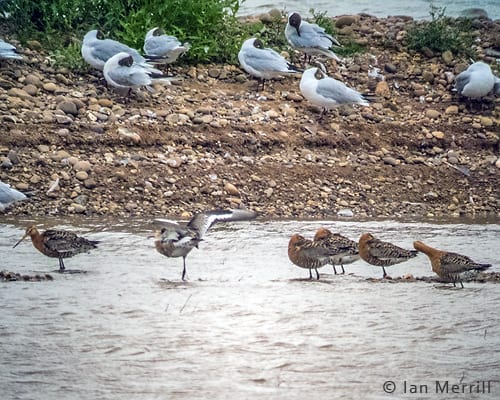
Black-tailed Godwits & Black-headed Gulls
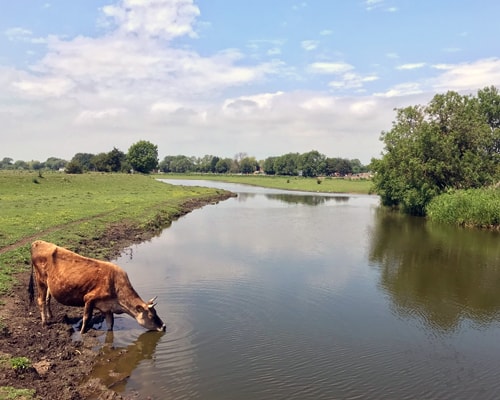
The Trent/Soar Confluence
From the parking spot at SK48872907 a footpath leads directly north, following the River Soar to its confluence with the River Trent. This route leads to the flood plain and several oxbow lakes which also attract passage waders and are worthy of investigation at the appropriate times of year. At the River Trent follow the footpath west, parallel with the Trent and then turn to the south, to return to Ratcliffe Lane at SK48012990 and make a return loop to the car.
By following Ratcliffe Lane west to Sawley Marina one also passes through some interesting habitat of pasture and rough uncultivated land, which can be worthy of further investigation. Past records in this area include Corn Bunting, Tree Sparrow and Grey Partridge, though it is likely that at least one of this trio is now sadly extinct from the area. Merlin and Short-eared Owl have also been recorded in this area and the open landscape still appears ideal for these and other species which favour such habitat.
Close by, the stretch of the River Soar in the vicinity of the power line crossing at SK49192862 is the best site in the county at which to see Scarce Chaser dragonfly, during its late May to early July flight season.
Ian Merrill

Scarce Chaser