
Shawell
Grid ref: SP536808 (OS Landranger 140)

Location/Access
Shawell (pronounced to rhyme with towel) is a small village in south Leicestershire close to the border with Warwickshire. The closest large town is Lutterworth, where there is easy access to the area from the M1 motorway at junction 20. The area is split into several sites and parking is very limited at each of them:
Shawell Sandpit, adjacent to Gibbet Lane. Parking is very difficult at present, as the former parking area has been fenced-off due to fly-tipping. If you can’t find anywhere safe to park close to the sandpit you may have to park in Shawell village and walk back, nearest post code LE17 6AB. Do not park on Gibbet Lane itself, as access for large lorries is required at all times.
Shawell A5 Lagoons or Balancing Lakes have been a productive area, but much of it is now silting up and becoming overgrown. Viewing conditions are not easy and are very close to the busy A5 road. Parking is available in Newton Lane at SP 53218 79930, CV23 0TB, where there are several places that cars can be parked on the verge, but be aware that large lorries use this small lane to access a distribution area close to the junction with the A5.
Shawell Gravel Pit is a small overgrown sandpit or wash pool that can be viewed from the hedge on the south side of Gibbet Lane. There is room for a couple of cars at SP 53980 80559, LE17 6AB. From the parking spot you will have a view of the landfill site, but the tall hedge can make viewing difficult during the summer months.
A footpath runs between Gibbet Lane and the A5 Lagoons and passes close to some of the older sandpits. It can be walked either from the A5 Lagoons or Gibbet Lane, but it is not a circular walk.
This is a working area with many dangerous locations. Please stay on public rights of way and under no circumstances should you try to enter the landfill or quarrying areas.
Habitats
The area is dominated by a large sand extraction operation and a landfill site. The sand extraction has created several flooded pits of varying states of maturity. The newest pits are mainly barren at first, but as they mature reeds start to appear and eventually small trees. Several of the pits have become quite overgrown. There are a number of grassland habitats and also areas of woodland and mature hedgerows.
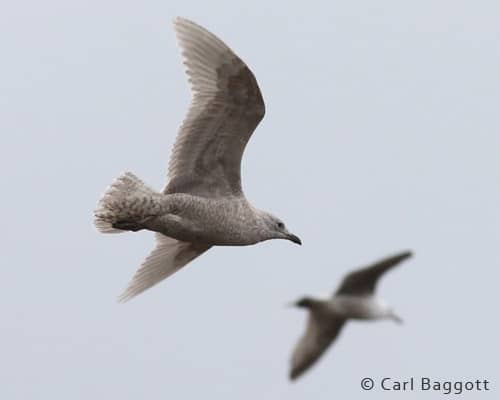
Iceland Gull
Birds
Shawell is best known for gulls in internationally important numbers. Amongst the masses of commoner species it is possible to find some scarcer ones. Iceland and Glaucous Gulls appear every winter in varying numbers and the form of Iceland Gull known as ‘Kumlien’s Gull’ has been recorded on several occasions. Caspian Gulls are present throughout the year in small numbers and Mediterranean Gull can be seen during passage periods. Three accepted Baltic Gulls have also been recorded, but this one is a real challenge.
Red Kites are resident and can be seen up close over the Shawell Sandpit. Other birds of prey have included Buzzard, Kestrel, Hobby, Marsh Harrier, Merlin, Osprey, Peregrine and Sparrowhawk. Waders pass through in spring and autumn and have included Avocet, Black-tailed Godwit, Grey Plover, Little Stint, Sanderling, Turnstone and Wood Sandpiper. The Shawell Gravel Pits have attracted Marsh Warbler in the past and more recently a Cetti’s Warbler. Black-necked Grebes have graced the A5 Lagoons and a Garganey stayed for three days at the Shawell Sandpit.
Commoner species like Reed Warbler can be seen in good numbers and a roost of c30,000 Starlings at the Gravel Pits in the winter of 2020/21 was particularly impressive. Stonechats and Wheatears are also possible at the right time of year.
Carl Baggott
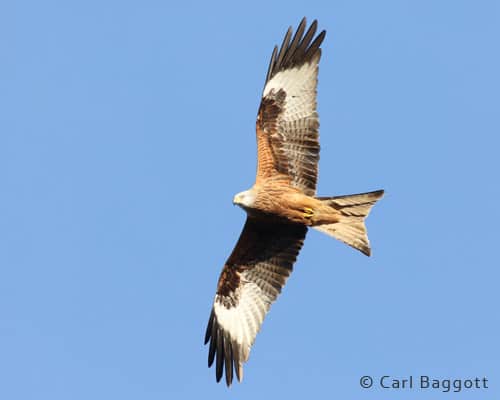
Red Kite