
Cropston Reservoir
SK 545 110 (OS Landranger 129)
Location/Access
Cropston Reservoir, a 49 hectare SSSI site owned by Severn Trent Water, should produce more birds than it does and can be very disappointing. This may well be to do with the shooting syndicate that regularly stalk the site, and the water levels which are often kept high. Little management was undertaken between 2004 and 2020 but significant clearance of willows choking the shore has recently commenced and should be completed in 2022. Hopefully, this will help improve the quality and variety of species using the water and surrounds.
There is no public access to the site and viewing is best from the small layby on Reservoir Road in Cropston at SK 55033 11080, LE7 7HS. Scanning from here late in the day can be problematic as you can be looking into the late afternoon sun. It may therefore be better to view from the viewing slots near the Deer Barn tearooms in Bradgate Park at SK 539 103. Park at Hallgates/Cropston car park – SK 54244 11383, LE7 7GB, and walk for about ten minutes. This is the best place for viewing the western shore and inflow especially when the water levels are lower in autumn.
Birds
Numbers of wildfowl are variable in winter and have been decreasing significantly in recent years which may be to do with the quality of the water. It is noticeable that the nearby Swithland Reservoir gets much greater quantities of Tufted Duck, Pochard and Shoveler. Whilst it is not unknown for Scaup, Smew and the rarer grebes to drop into Cropston Reservoir, they are more likely to rest up and feed at Swithland Reservoir.
Large flocks of hirundines can been seen during the migration periods and with them may come small numbers Little Gull, Black, Little and Sandwich Terns.
Given the right conditions, the inflow of Cropston Reservoir can be good for waders, and Ringed Plover, Little Ringed Plover, Lapwing and Shelduck have bred in recent years. Should the shoreline be visible during the autumn migration then Black-tailed Godwit, Dunlin, Green, Wood and Common Sandpipers will drop in. The occasional Garganey also feed in the area.
Winter gull roosts consist mainly of Black-headed Gulls with the occasional Mediterranean Gull but large white-winged gulls are few and far between.
Little Egrets are becoming more commonplace with double-figure counts occurring since 2012, the current maximum being 36 in 2016. The first Great White Egret was in 2018 and now one or two are frequently recorded.
Over recent years Ospreys have been an increasing sight during the summer months; it can’t be too long before they breed somewhere in Charnwood.

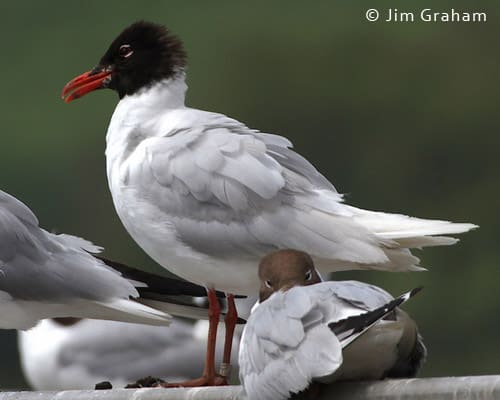
Mediterranean Gull
Rarities
As with any inland reservoir, interesting birds can turn up at any time. Divers are few and far between: just six Red-throated have been recorded, the last in 2003; five Black-throated Divers, the last in 2003, and three Great Northern Divers, the last in 2006. Black-necked Grebes have been recorded in ten years since 1947, mostly singles, but five occurred in both 2003 and 2019. Slavonian Grebes have been recorded in eight years, mostly singles, the last being in 2014. Although recorded in 12 years, until one in December 2020, the previous Red-necked Grebe was in 1996.
Other highlights have included: Ferruginous Duck (1990), Eider (1982), Quail (1976), Velvet Scoter (1976), Gannet (1976), Temminck’s Stint (1972), Purple Sandpiper (1956), Grey Phalarope (1971) and Great Skua (1979).
More recently: Long-tailed Duck (2000), Red-breasted Merganser (2013), Black Stork (2018), Spoonbill (2017), Turnstone (2015) and Pectoral Sandpiper (2017).
Jim Graham
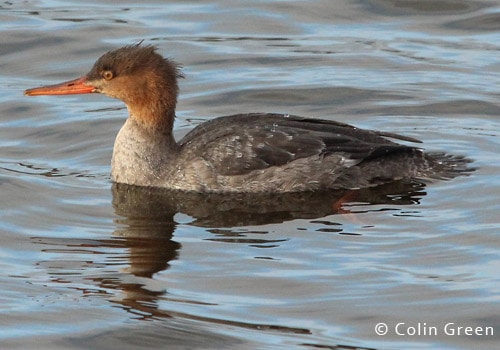
Red-breasted Merganser